Pre-order Cence HV, our fault-managed power system here

Pre-order Cence HV, our fault-managed power system here
Electrical Engineers & Specifiers
Centralized power conversion reduces ceiling-plenum infrastructure while supporting NEC Article 725 and UL 924 compliant lighting systems.
Cence · Electrical Engineers
What Centralized DC Power Unlocks for Specifying Engineers
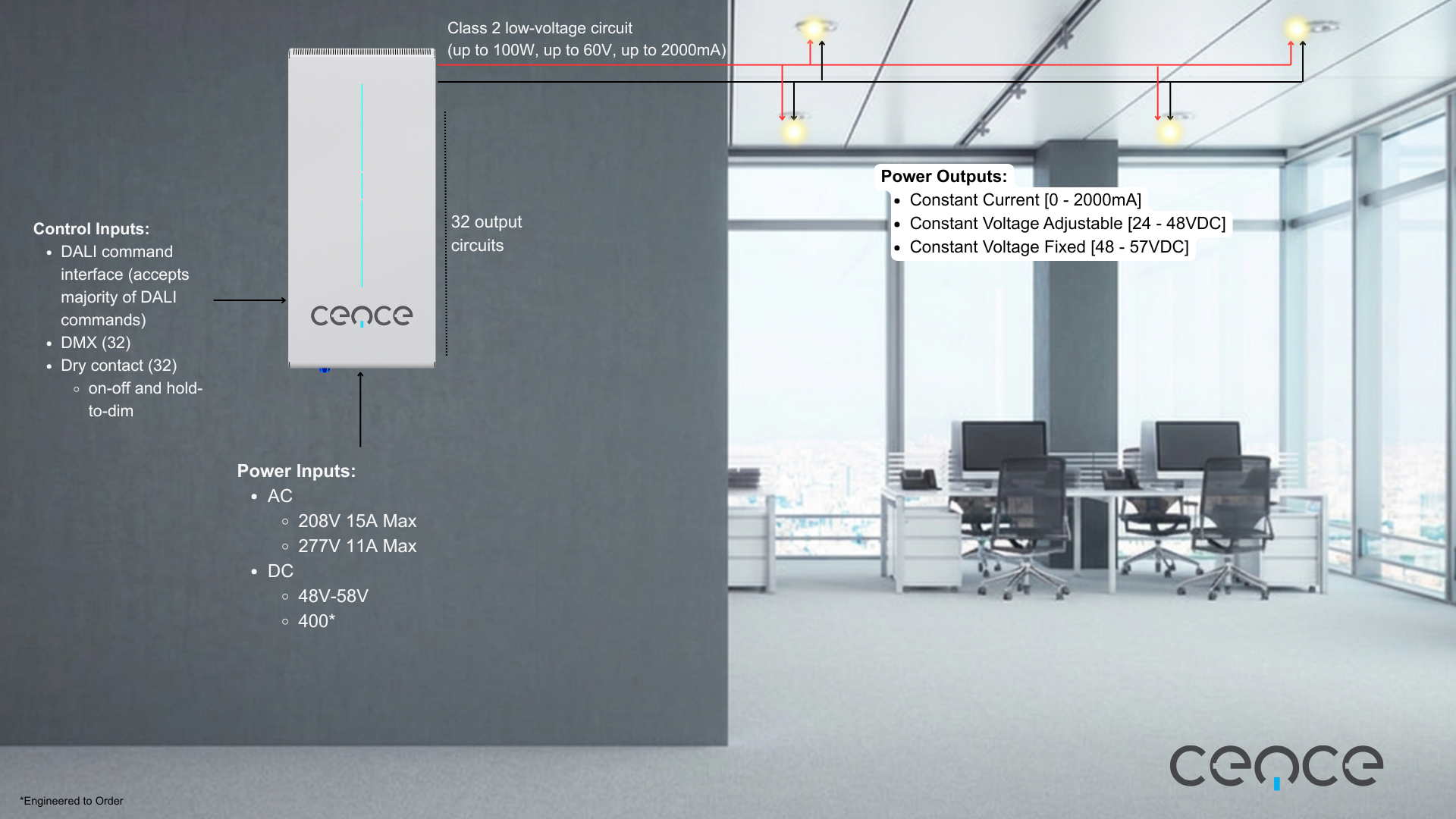
Power outputs are limited to 100VA per channel under UL 1310 Class 2 requirements, helping satisfy NEC Article 725 limited-energy circuit requirements.
Traditional lighting systems often require distributed power conversion, branch wiring, conduit runs, and coordination between multiple trades. By centralizing AC-to-DC conversion and distributing low-voltage power, Cence can simplify installation pathways, reduce material requirements, and help control construction costs.
The Cence LV Hub receives AC power, converts it to DC, and distributes Class 2 power to connected LED lighting. This establishes a clear Division 26 and Division 27 scope, with electrical contractors installing the hub and low-voltage installers deploying the Class 2 cabling.
Traditional line-voltage lighting systems often require conduit, junction boxes, and associated labor throughout a building. By distributing Class 2 power, Cence can reduce infrastructure requirements, lower installation labor, decrease material usage, and support faster project delivery.
Engineering Priorities
Every project balances code compliance, cost, reliability, and performance. Explore the priorities that matter most to your electrical design.
System Integration Mapping
Actual system configuration, output levels, and code compliance depend on the approved design and listed system limits for each project.
Sustainability
The Cence LV Hub distributes power using Class 2 circuits designed around the requirements of NEC Article 725. Because Class 2 circuits are power-limited, engineers can leverage a well-established code framework for low-voltage power distribution while simplifying portions of the lighting infrastructure compared to traditional line-voltage systems.
Traditional lighting systems often require technicians to access ceilings, open access panels, rent lifts, or work above occupied spaces to troubleshoot and replace failed power components. By centralizing power conversion within the electrical room, maintenance personnel can service power equipment from a single accessible location. In many facilities, this can reduce the need for ladders, lifts, ceiling access, and after-hours service work. In controlled environments such as cleanrooms, healthcare spaces, laboratories, or pharmaceutical facilities, centralized maintenance can also reduce the operational disruption associated with accessing equipment above the ceiling. The modular power architecture allows individual power modules to be replaced without servicing every connected luminaire. Depending on the installation, applicable codes, site procedures, and AHJ requirements, any qualified personnel may be able to swap the hot power modules quickly without extensive disruption to building operations.
Because power is distributed using Class 2 circuits, projects can often reduce the amount of conduit, junction boxes, and associated installation labor required throughout the building.
Get a project-specific assessment of code compliance, installation cost, and infrastructure savings.
Get a custom assessmentRegulatory & Compliance Note: System capabilities, performance metrics, plenum wiring configurations, trade boundaries, and emergency egress routing are subject to compatible luminaires, listed system configurations, local electrical codes, and AHJ (Authority Having Jurisdiction) approval.


