Pre-order Cence HV, our fault-managed power system here

July 30, 2026
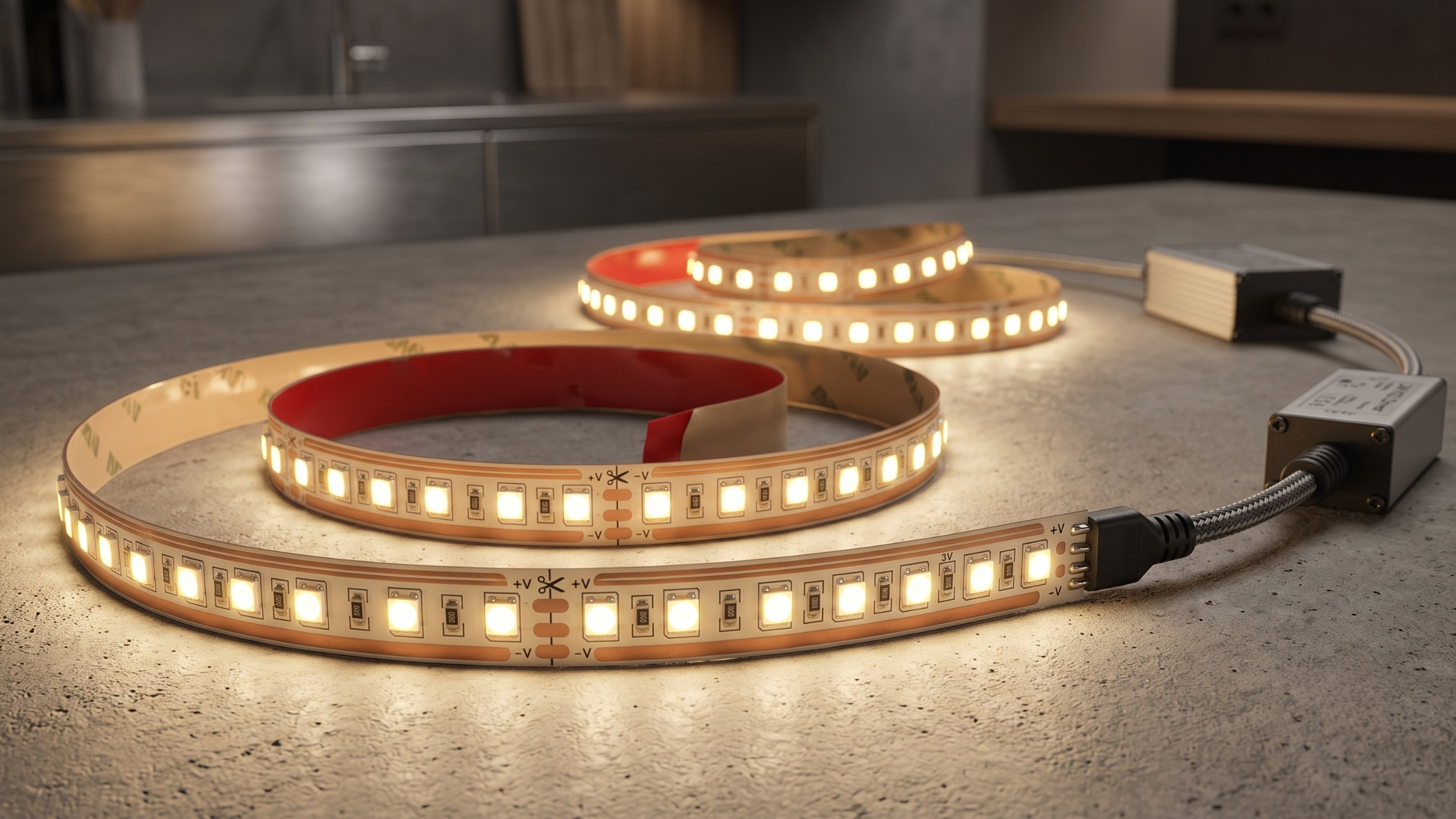
In commercial construction, LED tape lighting has become a standard solution for ambient and accent illumination. Its compact profile allows engineers, architects, and lighting designers to integrate continuous light into drywall coves, custom millwork, elevator cabs, ceiling slots, retail displays, hospitality details, and other locations where traditional luminaires cannot fit cleanly.
On product literature, low-voltage LED tape lighting is often associated with long rated life, commonly in the range of tens of thousands of hours. In real buildings, however, facility teams may encounter premature outages, visible dimming, flicker, color shift, and uneven output across long runs. These failures are rarely caused by the LED chips alone. More often, they result from poor power architecture, undersized conductors, excessive voltage drop, incompatible drivers, inadequate thermal management, or applying legacy AC distribution assumptions to sensitive low-voltage DC electronics.
This article examines six key areas:
LED tape light, also called LED strip light or ribbon light, is a flexible lighting product made from surface-mounted LEDs installed on a type of flexible printed circuit board. Unlike enclosed architectural luminaires, tape light functions more like a low-profile lighting material. It can be cut at designated points, routed through tight architectural details, and used to create continuous linear illumination in locations where rigid fixtures would be difficult or visually intrusive.
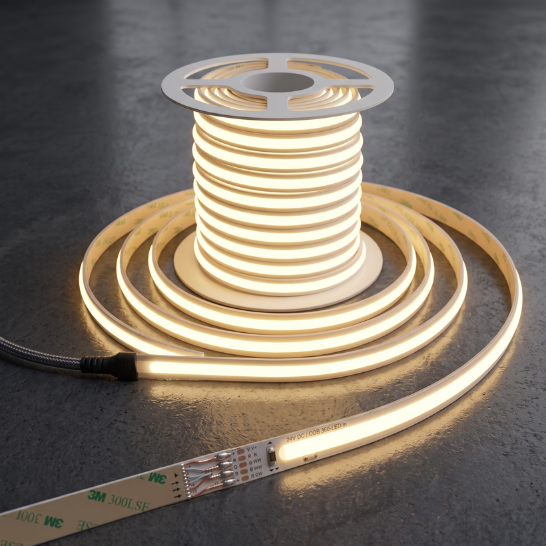
Because LED tape is a low-voltage DC product, its performance depends heavily on the quality of power that the LEDs receive. The strip itself does not behave like any other light source. It is an electronic circuit, and its brightness, color consistency, service life, and reliability are shaped by voltage, current, conductor length, load, heat, and driver compatibility.
The evolution of tape lighting in commercial buildings reflects a broader shift toward energy efficiency, architectural minimalism, and more integrated building systems. For decades, ambient cove lighting and linear details commonly relied on fluorescent T5 or T8 lamps. These systems were functional for their time, but they were rigid, bulky, dependent on localized ballasts, and prone to socket shadows where one lamp ended and the next began.
Flexible LED tape lighting became a practical architectural lighting product later, especially around the early 2000s, as surface-mounted LEDs were combined with narrow flexible circuit boards, adhesive backing, and low-voltage driver systems. This format allowed manufacturers to create cuttable, low-profile linear lighting that could fit into coves, millwork, retail displays, hospitality features, and other tight details where traditional strip fixtures were difficult to conceal.
As tape lighting improved, it moved beyond simple decorative accent use and became a common tool for commercial interiors requiring continuous, low-profile illumination. Higher diode densities, better color consistency, improved diffusion methods, and more refined power options helped expand tape lighting into corridors, coves, shelving, elevator cabs, ceiling slots, and other architectural applications where visual uniformity and serviceability matter.
To evaluate how tape lighting should be powered, it is important to understand the ribbon as an exposed, flexible circuit rather than a conventional fixture. A typical low-voltage LED tape assembly includes several key components.
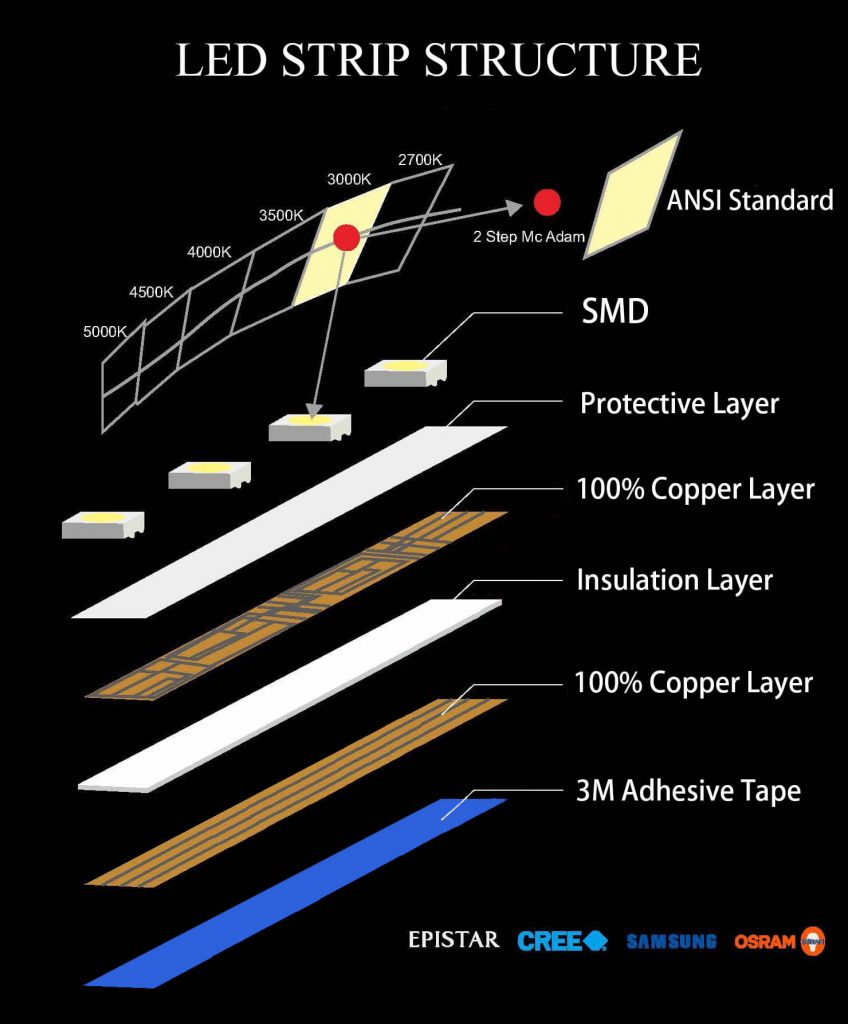
Once the physical structure of tape lighting is understood, the next question is electrical: how should power be delivered so the ribbon remains stable, bright, and consistent over time? That question begins with the distinction between constant voltage and constant current.
Most commercial tape-light systems are powered using one of two electrical approaches: constant voltage or constant current. Each method affects installation flexibility, brightness consistency, efficiency, dimming compatibility, and long-term reliability.
Constant-voltage tape lighting operates from a fixed-voltage supply, most commonly 12V or 24V, with some commercial systems using 48V. In this topology, the remote driver maintains a steady output voltage, while the tape-light segments limit current locally through on-board resistors. Some tape-light products also include voltage-regulating chips to help maintain more consistent output across longer runs, improving brightness uniformity from one end of the tape to the other.
12V constant voltage is useful for short, precise, field-cuttable runs such as shelves, millwork details, under-cabinet lighting, and small decorative applications. Its shorter cut intervals can be helpful when exact lengths matter. The trade-off is that 12V systems carry higher current for the same wattage, which makes them more vulnerable to voltage drop, heat, and visible brightness inconsistency over distance.
24V constant voltage is the common commercial baseline because it balances availability, efficiency, run length, product selection, and field flexibility. Compared with 12V, a 24V system requires less current for the same power level, which reduces voltage-drop effects and allows longer practical runs. For most commercial coves, corridors, retail details, and architectural features, 24V is the most familiar and widely supported constant-voltage platform. However, 24V systems still have practical distance limitations, and voltage drop must be carefully managed on longer commercial runs.
48V constant voltage can be useful for longer commercial runs because higher voltage reduces current for the same load, helping limit conductor losses and voltage drop. The drawbacks are longer cut intervals, reduced product availability compared with 24V systems, compatibility requirements for drivers and controls, and the need for careful coordination with listing, installation instructions, and applicable electrical code requirements.
Pros of constant voltage: Broad product availability, strong field flexibility, simple wiring, compatibility with many standard 12V and 24V tape products, easier cutting at designated marks, and straightforward replacement in many commercial applications.
Cons of constant voltage: Voltage drop can still occur through conductors, connectors, and the tape’s copper traces. As distance increases, the far end of the run may appear dimmer or shift in color (unless voltage regulator chips are included on the tape). Long runs require proper voltage-drop calculations, suitable wire gauges, shorter segments, end feeding, power injection, or additional outputs.
Constant-current tape-light systems regulate current rather than voltage. The driver or centralized power equipment supplies a defined, pre-programmed current, and allows the voltage to vary within its rated range in order to hold that current steady through the circuit. In many constant-current tape-light designs, current regulation is shifted away from simple onboard resistance and handled primarily by the external driver or centralized power equipment. By reducing reliance on onboard resistors and voltage-regulating components, constant-current tape-light systems can improve luminous efficacy, measured in lumens per watt (lm/W), by minimizing power losses that would otherwise be dissipated as heat.
Pros of constant current: more consistent operating conditions for the LEDs, improved brightness uniformity, reduced visible effects of voltage drop, better color consistency across longer runs, and improved system efficiency when the product and driver are properly matched.
Cons of constant current: While constant current tape is cuttable, and can be changed in the field, the driver current will have to be reprogrammed to match the current requirements based on the length of the tape segment. They may also have narrower product availability than standard constant-voltage tape.
LED tape lighting has become popular because it solves architectural problems that conventional fixtures cannot address as cleanly. Its strengths include:
Once the tape-light type has been selected, the next design question is how power should be distributed. For commercial applications, the choice is not only between constant voltage and constant current. It is also between distributed drivers located near each run and centralized DC power infrastructure that consolidates power conversion, protection, and control.
A common approach is to install a 24V driver near the tape-light run, often above a ceiling, inside a millwork cavity, or in a nearby serviceable location. The driver converts line voltage to low-voltage DC close to the load.
Advantages: Short low-voltage wire distances, familiar installation practice, compatibility with standard 24V tape, and straightforward troubleshooting when the driver remains accessible.
Limitations: drivers can become scattered throughout the ceiling space, making maintenance difficult. Access panels may be required, driver locations may conflict with architectural details, and future service can become disruptive. This approach can also multiply points of failure across a large commercial installation.
In a centralized 24V DC architecture, power conversion equipment is consolidated into a central hub or remote driver cabinet rather than being distributed above ceilings or inside millwork. The system supplies regulated 24V DC outputs to multiple tape-light circuits.
This method maintains compatibility with standard 24V constant-voltage tape-light products while improving serviceability. Because the power equipment is centralized, facility teams can access, maintain, and replace power components from a more controlled location.
Advantages: compatibility with common 24V tape, support for field-cuttable configurations, centralized monitoring and control, and the ability to manage multiple lighting circuits from one platform.
Considerations: voltage drop can still occur between the centralized source and the tape, as well as along the tape itself. Designers must account for wire gauge, run length, load, connector losses, driver capacity, dimming method, thermal conditions, and code or listing requirements. Long runs may require separate home runs, shorter segments, larger conductors, or feeding from more than one point.
A centralized remote driver cabinet for constant-current architecture takes a different approach. Instead of distributing a fixed 24V output, the system regulates current to the lighting circuit and adjusts voltage within its rated operating range to maintain the specified current.
Advantages: Can improve brightness consistency on products specifically designed for constant-current operation, provides better color stability across longer runs, offers centralized service access, and delivers stronger performance in applications where visual uniformity is a critical design requirement. By removing onboard current-regulating resistors, these specialized systems can also improve overall energy efficiency at the fixture level.
Considerations: constant-current systems require programming current specific to the length of tape in the field. The LED load must match the driver or hub (driver cabinet) output, the total forward voltage must remain within the rated range, and layout changes after installation may require recalculation. This method is best suited for projects where run lengths, loads, and performance expectations are defined early.
The best powering method depends on the installation objective.
For small jobs with short, field-cuttable runs where flexibility is the priority, localized or centralized 24V constant-voltage distribution remains a practical solution. For large jobs with longer commercial runs where brightness consistency and serviceability are more important, centralized DC distribution should be strongly considered. For applications where the highest level of uniformity is required and the layout is fixed, centralized constant-current distribution can be the stronger engineering approach.
Regardless of topology, the design should account for maximum run length, conductor size, voltage drop, load capacity, derating, dimming compatibility, service access, thermal management, mounting surface, environmental conditions, and compliance with applicable electrical codes and manufacturer listing requirements.
LED tape lighting has become a foundational architectural lighting solution because it is flexible, compact, efficient, and capable of producing continuous lines of illumination in spaces where traditional fixtures cannot be easily integrated. Yet the tape itself is only one part of the system. Long-term performance depends on how power is delivered, controlled, protected, and maintained.
In short, the best way to power commercial tape lighting is not simply to place a driver near the ceiling and hope the strip performs to specification. The power architecture must be designed as a part of the lighting system. Centralized DC distribution and remote driver cabinets gives designers and contractors a more serviceable and scalable foundation, while the choice between constant voltage and constant current should be driven by the project’s tolerance for voltage drop, required visual uniformity, field flexibility, and maintenance strategy.
For many commercial projects, centralized, remote 24V constant-voltage distribution offers the best balance of flexibility and practicality. For longer, more demanding runs where consistency is critical, centralized constant-current distribution can provide a more refined engineering solution. The strongest design is the one that treats tape lighting not as a decorative afterthought, but as a coordinated electrical system.
To learn more about Cence, click here.