Pre-order Cence HV, our fault-managed power system here

June 9, 2026
Discover how a native DC2DC lighting architecture removes the legacy AC conversion detour to structurally lower upfront hardware costs and system waste.
Picture a modern 50,000 square foot office building where solar panels generate power on the roof, smart systems manage operations across every floor, and everything from LED lighting to EV charging stations and connected devices operate as part of a connected, electrified environment. It looks advanced. It behaves intelligently. But underneath, it is still powered in a way that does not match how its technology actually works.
Most of the systems inside that building run on Direct Current (DC). LEDs, batteries, semi-conductors, and digital control systems are all fundamentally DC-based. Yet buildings continue to distribute Alternating Current (AC) to loads, forcing every device to convert power before it can operate.
Lighting is one of the first places where this mismatch becomes both visible and economically meaningful.
In a typical commercial building, every LED fixture performs its own AC-to-DC conversion. That means hundreds of independent conversions happening at the same time, each wasting energy as heat and introducing another point of failure.
DC2DC lighting changes this model.
Instead of converting power from AC at every fixture, it keeps power as Direct Current throughout the system and uses simple, efficient DC-to-DC conversion only when needed.
For contractors, engineers, architects, and building owners evaluating lighting systems, this shift has a direct impact on efficiency, sustainability, reliability, and total cost of ownership.
DC2DC lighting is a lighting system where power stays as Direct Current from the power source all the way to the light fixtures. Any voltage conversion that happens at the fixture level is DC-to-DC, meaning conversion between one DC voltage level and another, rather than conversion from AC to DC (also known as rectification).
In practical terms, this means:
The key advantage: you avoid the inefficiency of converting from AC to DC at every fixture. Instead, you convert once centrally and regulate simply at each light. This improves efficiency, reliability, and simplifies the electronics compared to traditional AC systems where each fixture has its own AC-to-DC converter. Additionally, DC architectures cut out electrolytic capacitors which are often the first part to fail in traditional line-voltage drivers, significantly improving overall fixture lifespan.
DC2DC lighting is fundamentally different from traditional lighting because it keeps electrical current in the same form (DC) for as long as possible, only converting voltage as needed at the final point of use.
In traditional buildings, every LED fixture contains its own AC-to-DC converter. Power arrives as Alternating Current (AC) from the utility. A rectifier inside the fixture transforms it to Direct Current (DC). Then the LED gets the current it needs to be driven.
This works. But is it efficient? Let’s dig further.
A typical spec-grade AC-to-DC converter achieves 80-90% efficiency. That means 10-20% of the energy gets wasted as heat, right next to the LED. Over time, sustained heat degrades the converter's electronic components (namely the electrolytic capacitor). As components degrade, they become less efficient, generating more heat. This positive feedback loop is called thermal runaway, and in practice, electronic driver failure becomes the dominant life‑limiting factor in the system. This is also what causes flicker and strobing, and it’s why most fixture warranties are capped at 5 years.
Now multiply that by hundreds of fixtures in a typical office building. You're accepting this inefficiency hundreds of times over. You're running separate converters, each with its own heat generation, component degradation, and failure risk.
The problem compounds when you consider that each of these converters is doing the same job independently, with no coordination, no optimization, and no way to manage them as a system.
Direct Current (DC)lighting is the overarching approach of distributing DC power from a central source to your fixtures. However, depending on your building’s requirements for control and distance, this is achieved in two technically distinct ways.
The Driverless System (Centralized Constant Current or Constant Voltage):
In this architecture, the central power source acts as the “brain” for the entire zone, and manages dimming. It distributes a regulated constant current or constant voltage directly to the luminaires. Because the current or voltage is already regulated at the source, the fixture contains no on-board driver.
The DC2DCArchitecture (Constant Voltage):
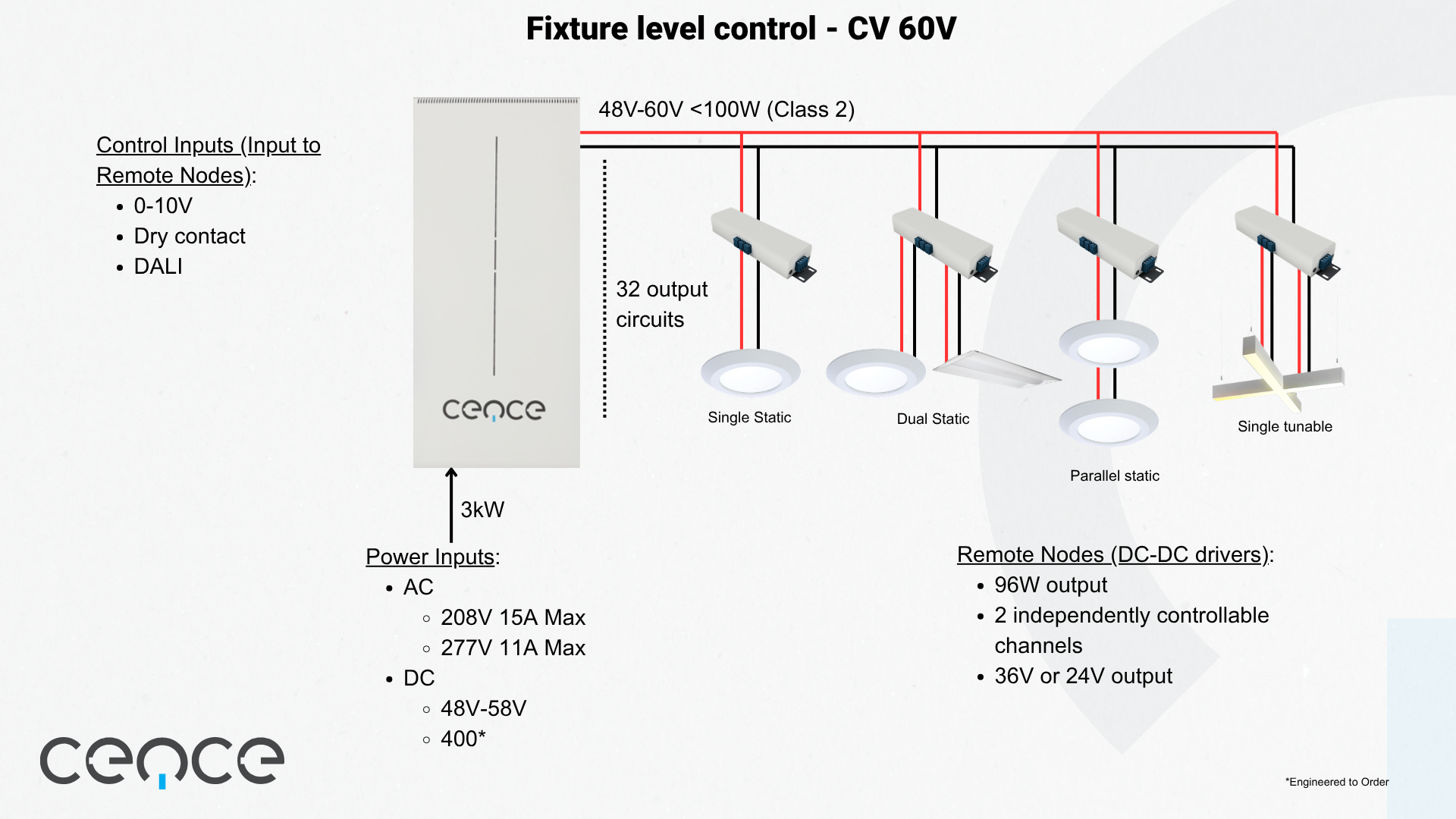
In this model, the central source provides a constant voltage to fixture-level DC-to-DC drivers. This voltage can be up to60V DC according to Class 2 rules in the NEC and CEC. Because the voltage is constant, you need a secondary regulation stage at the fixture to provide the LEDs with the correct amount of current. A small DC-to-DC converter sits at the fixture to regulate that constant voltage into the exact current or voltage the LED needs. This is the preferred method when you need individual fixture addressability or control.
In a DC2DC architecture, the driver at the fixture is fundamentally different from a traditional AC driver. Because the complex task of AC-to-DC rectification has already happened at a central point, the circuit at the fixture is stripped down to its most essential function: regulating one DC voltage into another.
Here is where the architecture of your DC distribution makes or breaks the system.
Electricity traveling through cables naturally loses voltage due to the resistance of the copper wire. Over long runs, this voltage drop can become substantial, but its impact depends heavily on your starting voltage.
Many low-voltage lighting systems operate at 12V or 24V DC. If you experience a 7.5Vdrop over a long cable run, you have lost over 30% of your voltage in a24V system. The lights at the end of the line will dim, flicker, or fail to turn on entirely.
To solve this without reverting to traditional AC infrastructure, DC architectures use one of two highly effective methods:
Instead of distributing 24V, the central power source distributes power near the maximum safe limit for Class 2 low-voltage wiring—typically around 57V to 60V DC.
Let’s look at areal-world calculation for a worst case scenario; a 350-foot run using standard18 AWG cable:
At the fixture, a simple DC-to-DC LED driver steps that stable 51V down to the exact 24V the LED requires. You get perfect, uniform brightness across massive distances using standard, inexpensive low-voltage cabling.
Alternatively, in a centralized Constant Current architecture, the central Hub acts as the "brain" and handles the voltage drop automatically.
Instead of a local driver stepping voltage down at the fixture, the central Hub monitors the line and simply pushes the voltage higher at the source to overcome the cable's resistance. It dynamically compensates for the line loss, ensuring the exact required current reaches the luminaire at the end of the run. This completely eliminates the need for any driver circuitry at the fixture itself.
The limitations of traditional AC lighting systems are not driven by LED technology itself, but by how power is distributed and converted. Voltage drop, distance, heat, and reliability issues are systemic outcomes of forcing alternating current infrastructure to support devices that operate natively on direct current.
DC2DC lighting addresses these limitations by rethinking the role of conversion and regulation across the system. By converting power once and distributing Direct Current throughout the network, DC lighting systems eliminate redundant conversion stages, reduce localized heat, and create a foundation that scales more efficiently across distance and application types. In turn this reduces construction and maintenance costs and energy consumption.
At this point, the technical case for DC2DC lighting should be clear. The more important question becomes how this design principles performs in real environments where buildings, outdoor spaces, renewable energy, and high bay systems impose different operational constraints.
That is where theory meets practice.
Part II - Coming soon - DC2DC Lighting in Practice: buildings, outdoor, solar, and high-bay systems.
If you are evaluating DC lighting for a specific building, site, or renewable project, understanding whether DC2DC architecture fits your constraints is the next step. Our team at CencePower works with engineers to assess DC lighting feasibility based on distance, load, and lifecycle cost.
Talk to a DC lighting specialist